Sir Hubert Williams
When You Were MineSir Hubert Williams is the magistrate who meets Peter Davenport and Dominic Cavendish at the grave of the woman they believe to be Isobel Davenport. He is introduced as a tall, gaunt official, but his authority does not settle the mystery: his answers are incomplete, and his private reflections reveal that he has played a concealed part in events. The gap between his public role in the graveyard and his unease afterward makes him a figure through whom the novel complicates the reliability of local justice.
Identity and Introduction
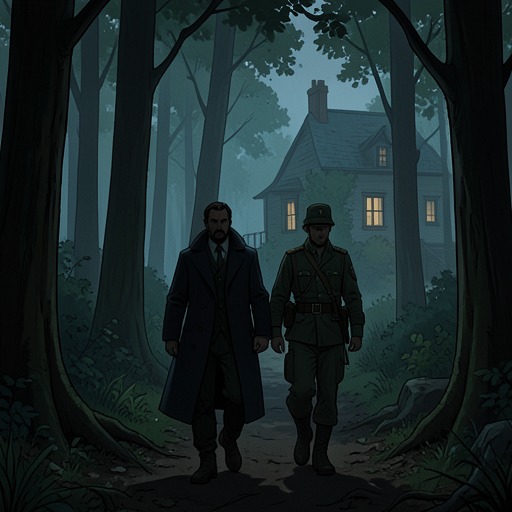
Sir Hubert arrives by curricle in the graveyard, picking his way among the gravestones before introducing himself with a small bow as the magistrate. His formal greeting meets a cold reception. Peter, who has no interest in observing social etiquette, responds stiffly, while Dominic offers only a brusque nod. The two men’s military bearing and barely restrained anger establish at once that this is not an ordinary official visit; Sir Hubert is entering a confrontation shaped by grief and suspicion.
He asks whether they knew the woman indicated by the dark soil. Peter identifies her as his sister and asks about the sole object found on her body. Sir Hubert produces the necklace, visibly shaken by the men’s response. Its significance is established before he can explain it: it is Isobel’s star necklace, a keepsake from her father that she had worn continuously and would not have willingly abandoned. The object turns the graveyard encounter from an inquiry into a confirmation that Peter and Dominic find horrifying.
The Graveyard Inquiry
Peter says that Isobel should be resting in the family crypt and proposes arranging her removal. Dominic, meanwhile, fights to keep his anger under control and asks Sir Hubert what is known about the circumstances of her death. The magistrate reports that there is little information, despite having questioned the farmer who found her. According to the farmer, the woman had not been there the previous afternoon; she appeared sometime between dusk and dawn.
Sir Hubert pauses before completing the account. Dominic supplies the grim conclusion that the body was dumped, but he also senses that the magistrate is not telling them everything. The exchange leaves Sir Hubert’s official explanation unresolved: he provides the discovery’s broad circumstances but not a complete account of what happened. His hesitation, and Dominic’s suspicion of it, make the investigation turn on the possibility that the evidence presented at the grave is only part of the story.
A Concealed Part in Events
After Peter and Dominic ride away, Sir Hubert watches them disappear into the fog and privately expresses relief that the encounter has passed without disaster. He hopes they will leave the area before discovering the truth. His anxiety is not simply about the two men’s threatening presence: he recalls having promised a friend long ago to take whatever action was necessary if called upon, and says that he did so. He now doubts whether the actions he took a month earlier were sound, even if they were well intended.
That admission does not explain exactly what Sir Hubert did, identify the friend, or establish the full truth he fears will be uncovered. It does, however, change the significance of his graveyard conduct. His limited answers and strained composure may be read alongside his knowledge that he helped secure a particular outcome. He recognizes Peter and Dominic’s distress as genuine, and wonders why he was asked to bring about that outcome in the first place. His concern about whether to reveal the truth remains unresolved as he leaves the graveyard.
The empty grave in the far corner, marked by a small cross, gives that uncertainty a concrete setting. Sir Hubert looks toward it as he passes. The image undercuts the apparent finality of the burial: the men have identified the body by the necklace, yet the grave is empty, and the magistrate’s private doubts point toward information still withheld. The scene therefore makes his office part of the mystery rather than a guarantee that it has been settled.
Legal Authority and the Larger Plot
Later, Isobel recounts that Rupert Davenport came to Willowbrook Hall after two and a half weeks there and announced that Peter had died in Norfolk. Rupert said that a magistrate named Worthing had informed him of the death and that this made him Isobel’s legal guardian. Isobel, shocked and given little time to pack, left with Rupert after securing his promise that Elspeth would not be sent to an asylum; she insisted that Kitty accompany her. This account shows how a claim of official authority could be used to hasten Isobel’s removal, but it names Worthing, not Sir Hubert. The novel does not establish that the two magistrates are the same person, and Sir Hubert should not be assigned Worthing’s role on this evidence.
The surrounding plot repeatedly makes documents and legal claims consequential. Peter explains that Gosport Hall had been inherited by Isobel from her father, although the family had left it closed and unused. Isobel later recalls that Rupert tried to force her to sign a betrothal document naming DeLisle as her intended; she refused, and the others understand that she was beaten for resisting. During the confrontation with Rupert and DeLisle, Peter invokes his guardianship and says that he had not consented to Isobel’s marriage to anyone except Lord Havistock. He also cites papers, witnessed by magistrates, recording her betrothal to Dominic three years earlier. These details frame the authority Sir Hubert represents as part of a wider contest over testimony, guardianship, and marriage, though none proves his personal involvement in those later disputes.
Narrative Role and Significance
Sir Hubert’s appearance links the investigation of Isobel’s supposed death to a larger problem: the difference between an official account and the truth that account may conceal. At the grave, he has the position to question the farmer and present the necklace, yet his report is hesitant and incomplete. Alone afterward, he admits to prior involvement and fears that Peter and Dominic will discover what happened. The contrast is not resolved into a confession; it leaves the reader with both a clue and an unanswered question.
His characterization is consequently defined less by a fully disclosed motive than by divided conduct. He performs the public duties of a magistrate, but his private doubts show that he has acted at a friend’s request without feeling certain that the action was right. The men’s recognition of Isobel’s necklace supplies apparent proof, while the empty grave and Sir Hubert’s foreboding destabilize that proof. Through him, the supposed death becomes not merely a matter of identifying a body but an inquiry into who arranged the outcome, what they knew, and whether authority has helped preserve a false account.